How We Built a Star Ceiling Home Theatre

A behind-the-scenes look at one of our most popular installations: a fibre optic star ceiling with 4K projection and Dolby Atmos.
A recent home theatre project gave us the chance to pull together every element we work on into a single room. It's worth walking through because it shows how lighting, audio, video, and automation come together when they're planned as one system rather than stitched together afterwards.
The client converted an unused garage. We started with acoustics: resilient-mounted plasterboard on isolation clips, mineral wool insulation in the cavities, and a separate HVAC supply routed through a silencer to keep system noise under the audible threshold when the film is quiet.
Speaker positioning followed the Dolby Atmos reference layout. Every cable run was pre-wired to the rack location before plaster, so once the room was painted, the only visible hardware was the four ceiling speakers and the projection screen itself.
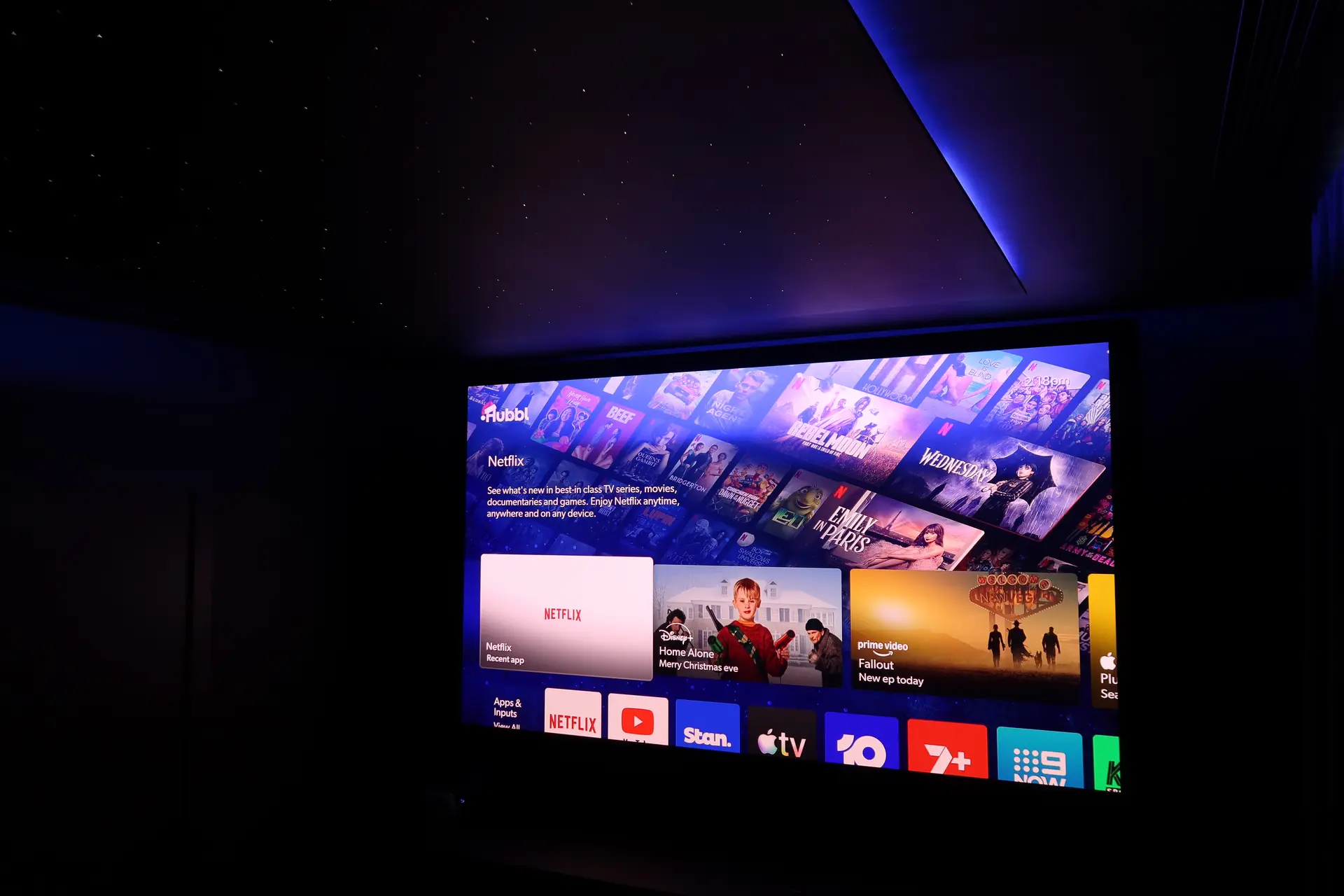
The fibre optic star ceiling was built in three panel sections. Each panel took about a day to populate with fibre runs at varying lengths to produce the depth effect. A twinkle driver connected to the home automation controller handles the random fade that gives the ceiling its natural feel.
Projection went through a tricolour laser projector with an anamorphic lens for 2.35:1 content. Calibration was done to D65 for SDR and a separate HDR preset, both tied to scenes so the projector picks the right mode based on what's playing.
Scene programming is where the install really earns its keep. A single 'Movie' button on the wall or the app closes the blinds, dims the lights to 3%, cues the star ceiling, powers up the AV rack, lowers the screen, and fires the projector. A 'Pause' scene raises the lights to a comfortable reading level. An 'End' scene returns the room to ambient lighting.
The feedback from the client matched what we hear most often about this type of build: once they'd used the 'Movie' scene a handful of times, they stopped thinking about the system entirely. The room just works.
Key takeaways
- Acoustic treatment and HVAC planning happen before any cabling.
- Every cable run is pre-wired before plaster goes on the walls.
- Scene programming is what turns a home theatre into an experience.